Saturday, February 20, 2016

Book Review - Lips Too Chilled, Matsuo Basho

Lips Too Chilled, Matsuo Basho (Image Source - Google)
A book that is just as big as the form of poetry – haiku – it carries. In fact, it is wrong to even term it as a book. It is actually a booklet. Nothing fresh about it either (which made me take away one star from the rating). All the haiku poems in this booklet are randomly chosen from the book ‘On Love and Barley’, which carries the works of Basho. So, if you want to read the works of Basho, pick up either ‘On Love and Barley’ or ‘The Narrow Road to the Deep North’.

As for the contents though, it is filled with the mesmerizing magic of Basho, which can transport the reader to the very scene that he is depicting. Lucien Stryk has done a good job in translating the works, carrying the spirit, wit and loveliness of haiku poetry, though not their structural rule and grammar. But what matters at the end of it all is the fun and bliss of reading haiku, isn’t it?!

A lovely sample for anyone getting his/her first taste of haiku, especially those by the genius Basho!

Thursday, February 11, 2016

Book Review – Pluto, Gulzar

Pluto, Gulzar (Image Source - Google)Just imagine this – you are blindfolded and led into a flower garden with so many exotic flowers of varied colors and shapes. The whole garden is a sight of absolute beauty. But, you are blindfolded and left to rely on your guide to realize the beauty of the garden. Now, your experience of this garden is limited to the capability of your guide to put in words what is in front of you both. If the guide happens to be a person of elevated taste, a keen sense of aesthetics and capable of efficient communication, you are lucky to relish the garden. On the other hand, if the guide is a sloppy communicator, all that you can get to know about the garden is some mundane description.

The same thing happened to me as I ventured into the world of Hindi poetry of Gulzar. This Gulzar – meaning ‘Flower Garden’ – deserves to be termed one of the best Hindi poets of all time. He even deserves to be called as one of the best poets of all time in the entire world, but I am not a capable judge in such matters. Now, my first experience of Hindi poetry happened to be the work of Gulzar, translated into English by Pavan K.Varma, a capable writer himself. With my knowing only a smattering of Hindi then, I had to fully rely on Pavan Varma to bring out the beauty of Gulzar’s poetry in its full glory and Pavan Varma did oblige me in excellent fashion. 

Later I went on to read more of Gulzar’s works, some translated by Pavan Varma, some others by Rina Singh, before finally managing to read the poems directly in the language in which they were written (Hindi), thus removing the blindfold from my eyes and getting a direct experience of the ‘garden’. Pavan Varma did an excellent job, and Rina Singh too did pull her weight to an appreciable extent. Having gone through all such translations, I found this translation by Nirupama Dutt to be a little disappointing. If you are a person who realizes the crucial role a translator plays – not just translating the words from one language to another, but ensuring their spirit stays the same – you will understand what I am trying to convey.

The poems all remain beautiful and full of Gulzar’s magic without doubt. The ability of this poetic genius to weave poems out of seemingly mundane, boring events of the day-to-day life is astonishing. He has this gift of portraying even the most banal of things in the most beautiful way – be it a single dry leaf rolling in the dirt, a tree swaying in the breeze, or the plight of those unfortunate souls who spend their entire lives on footpaths. The joy of love, the pangs of separation, the pathos of betrayal, the bliss of parenthood, respect for nature, concern for the environment – his themes form a very vast repertoire.

However, many of the poems in this book lack the usual vigor and magic of Gulzar and I can blame only the translator for the same. Some of the poems give you a sense of déjà vu and you would end up realizing your having already read those poems in other translations. And when you compare the translations, you would find that this translation lacks that magical dust to make these letters sparkle in front of your eyes.

But, the translation is not entirely bad. Nirupama Dutt has done her best in capturing the essence and beauty in many of the poems. May be I am a little biased, having already read the translations by Pavan Varma, which to me seemed to convey the beauty in those poems more clearly. A good treat to the fans of poetry, Gulzar’s especially, though not the very best of translations!

Friday, February 5, 2016

Book Review – Grandmother’s Tale, R.K.Narayan

There are many types of authors. Some of them, like the great Kahlil Gibran, teach us the basic truths of life with great eloquence. Some others, like the equally great Marcus Aurelius, teach the greatest of philosophies in the simplest of languages. And, then there are authors like R.K.Narayan, who have the knack of telling simple things in simple language and yet making it interesting enough. ‘Grandmother’s Tale’ is a sample for that talent of R.K.Narayan, who is famous more for his manner of telling a tale, than for the eloquence with which it is told. But, this book is a simple sample, though.

Said to be the last book of R.K.Narayan, and set in the era of British Empire in India, this book recounts the life of his great grandmother Balambal (mother of his maternal grandmother), as told by his maternal grandmother. Balambal, his great grandmother, gets married at the young age of 7 to a boy from her neighbourhood, Vishwanathan, who was 10 years old at the time of their marriage. After a bit of initial interest in his wife, an innocent pre-teen curiosity about her, Vishwa leaves the town with a group of pilgrims headed to the northern parts of the country, without informing anyone, except Bala.

Within a week’s time, the whole town sets in search of Vishwa, fearing the worst about his fate. Soon the dust settles and everyone comes to his/her own conclusion about Vishwa’s fate. Bala, being aware of her husband’s decision, remains confident though. But, when she starts growing up and turning into a woman, tongues start wagging about the possibilities of her having become a widow and thus being ineligible to visit the temple or lead a normal life as she has been doing. Infuriated, Bala leaves the village, vowing to come back with her husband.

After going through a lot of ordeals, she at traces her husband at last in Pune and manages to bring him back to her native village by cunning behavior and feminine obduracy. Then she goes on to lead a long, peaceful life with her husband and their offspring, till her death due to old age. The tale goes on to tell us about Vishwa, who lived for some more time with all the troubles related to old age and loneliness that plagues one after the demise of one’s companion of such long time, before meeting his death at the hands of a conspiring servant. 

A simple tale overall, the book is filled with the wit, twists and uncanny knack of RKN to make even the most ordinary of events seem interesting. What more, the book is embellished with lovely drawings by his famed sibling, R.K.Laxman. A worthy read, if you are looking to pass an hour of your time by reading a book that will be simple and yet riveting enough to be un-put-down-able.

'Grandmother’s Tale' – as interesting as only the grandmother’s tales can be!

Tuesday, February 2, 2016

Book Review – Words of Freedom: Ideas of A Nation, Vallabhbhai Patel

Q: Which leader is known as the ‘Iron Man of India’?
A: Sardar Vallabhbhai Patel.

Image Source - Google
This question above was my first introduction to Vallabhbhai Patel - fondly known as ‘Sardar’ for his leadership abilities - as I started getting my lessons in Indian history as a child. Having grown up admiring mainly Gandhi and Nehru, I only happened to have an occasional glimpse of the personality that ‘Sardar’ was. The portrayal of him as an antagonist of Subhash Chandra Bose, as found in one of Bose’s biographies, didn’t help his image in my mind. Also, the recent hijacking of Patel's persona by the Hindu Right/Radicals that projected Patel as one of their own, cast doubts in my mind about the greatness of this man. I started thinking of him as just another leader who happened to be an acolyte of Gandhi and hence got into the limelight. Man, how wrong I was!

As I started indulging more in Indian history, especially its post-Independence days, I grew more curious to learn about Patel. Was it really possible for a narrow-minded leader with a communal slant to have united the country without using much force and bloodshed? How could a leader, who prioritized the welfare of only Hindus, have managed to fuse the country of various ethnicities, languages and divisions of other kinds, into one strong nation? As these questions started tugging at my mind and made me feel guilty about carrying a negative opinion of a leader about whom I knew next to nothing, I decided to do what I do best - read.

‘Words of Freedom’ is an excellent book series by Penguin Publishers, which carries the speeches and writings of many of the past greats of India. Wisely selected essays and articles in these books give one a basic yet clear idea about the personality and thought-flow of the chosen great man - or woman. I picked up this book that carries the words of Patel as a first step towards learning about him.

I must confess, I have now got immense respect for Sardar Patel after going through this book. Here is a leader who didn’t mince his words, a character not conducive to a successful public life in a corrupt society like ours.  He was a man who called a spade a spade, was practical in his thoughts and deeds, had a will of steel, had pragmatic approach towards the society and the challenges. He had his dreams and visions of course, but he also saw the path towards the same in a clear manner. He wasn’t a starry-eyed ideologue hoping to form an Utopian Indian society. And, he DEFINITELY wasn’t communal!

I am stressing on the last sentence, because that’s how he was projected to me by my friends in Hindu as well as other-than-Hindu religions. He was someone who saw Indians as just that – Indians. He wouldn’t have treated you in any special manner just because you belonged to a particular religion, caste or sect. Also, he wouldn’t have mollycoddled you if you played ‘minority’ card. He had this ability to see the people based on their merit. No wonder he wasn’t and still isn’t popular among many.

His vision, his equanimity, his pragmatism, his moral strength, his indomitable will, his love for his country - are all nicely captured in this short book. A commendable job by Penguin Publishers.

But as the book progresses chronologically, towards the end you get a feeling that Sardar Patel died a disillusioned and disenchanted man, with his love for his country accentuating his pain for the ways in which the country had started deteriorating. Corruption, communal violence, lack of focus on the purpose on hand – that of strengthening the nation, and the citizens' plunging into selfish motives have all hurt him badly. Any sensitive reader could realize the pain and yet that undying hope in his words.

Wish this nation had had the fortune of seeing Sardar alive and in good health for another decade at least. He would have definitely changed the course of this country’s post-independence history and progress. A great leader in his own right, he was content to have kept to the shadows of the Gandhi during his time, staying on in the sidelines even after Gandhi’s demise, playing the role of an able and apt ally for Nehru. Iron Man, indeed!

Book Review - Few Things Left Unsaid, Sudeep Nagarkar

Image Source - GoogleI am someone who believes in completely reading a book, cover to cover, no matter how boring and insipid the book happens to be. Fortunately for me, I have seldom come across such boring books in my life. But this book is the first that I am dropping without completing and, hopefully, will remain the last too. Absolutely stupid, crappy and melodramatic writing!

If such senseless writing is called a best-seller, I pity the depravity that plagues the minds of people who 'enjoy' such books. I couldn't stomach it beyond 16 pages, and the following lines, in page 18 or so made me feel that I have had enough reading this crap - "I had heard from friends that degree colleges were like a girl's skirt. Men just want to see what is under it. Is the view nice? Is the service good?"

Really, Sudeep Nagarkar??? Will you be happy to share such writing with the women in your family and friends??? Dafuq!

'Few Things Left Unsaid' is a book best left unread!  :-(

Wednesday, December 30, 2015

A Winter Dawn's Learning

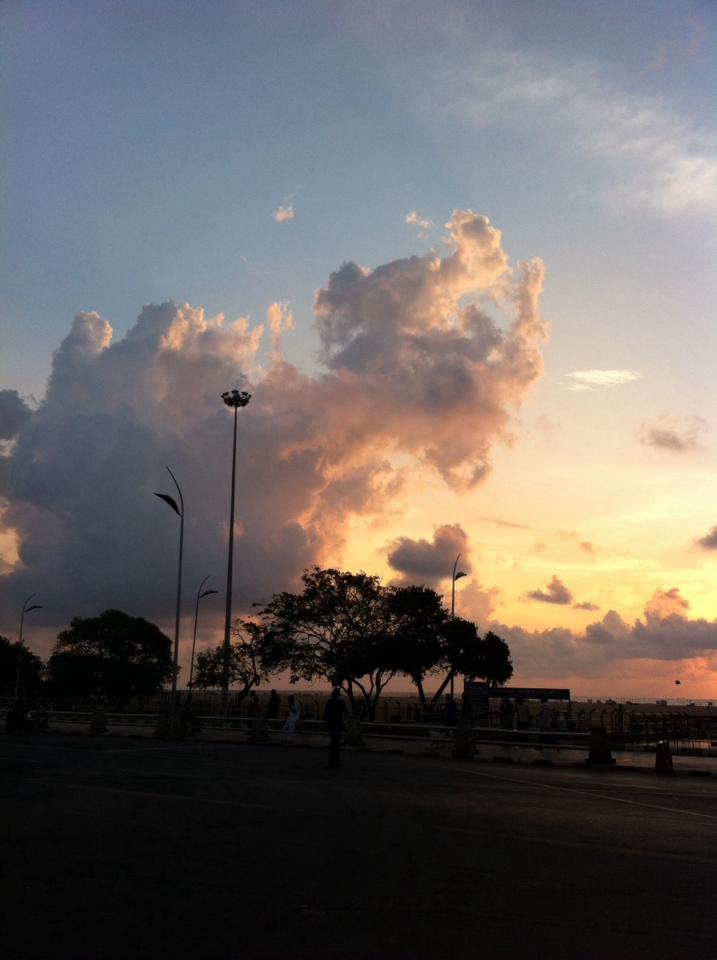
Sunrise at Marina Beach, ChennaiFrom the moment I started breaking into a run to the sound of Enrique crooning into my ears to the time when I eased into my destination after a hearty run, the Sun had changed into so many colors. From the ravishing robe of red to the glowing garb of orange, he tried so many hues of both colors, before finally settling for a majestic golden garment.

As I was indulging in the sight of yet another glorious sunrise, something came as a realization within me. How similar the daily sojourn of this Sun is to our lives!

Just imagine - the Sun's birth (sunrise) and his demise (sunset) are both events attracting a lot of attention, as anyone in love with Nature would vouch for. All that glory and colors of a Sunrise, akin to all that happiness and joy that abounds in a family at the arrival of a baby. And, all the gloom and darkness that engulfs the world at the sunset, no matter how ethereal a sight it turns out to be. Just the same way, the pain and sadness that afflicts a family at the death of a dear one, no matter how great or glorious the life had been.

What happens in the intervening period, between birth and death, then? We take the Sun for granted, just as we take our dear ones for granted. We complain about the heat, we don't appreciate the fact of the Sun being the source of all life and energy on our planet, and we don't care to acknowledge or even notice the presence of the Sun. Isn't that what we do with our dear ones too - taking them for granted, fighting over petty stuff, forgetting that the love we share is all that matters in the end, no matter what we own, what we wear and which earthly positions we occupy?

The Sun is the ultimate source of energy and life on our planet. The much ridiculed and oppressed pagans knew it. Modern science has given us the facts that affirm the pagans' belief. Similarly, the people in our lives are the source of our energy and happiness. Let's treat them with the respect, love and care that they deserve, instead of waiting for the 'Sunset' to realize and acknowledge the importance.

Also, not everyone gets to see the glory of the sunrise, but most of us get to partake in the beauty of the sunset. In the same way, not all our births are known or celebrated well. Let's ensure that when we 'set', we set in glorious grandeur! <3

Monday, December 28, 2015

Appreciation and the Price of Tender-Coconuts

This being the last week of current year and the first week of the new year, I decided to spend it by conveying gratitude to all the people in my life and around it. One of the ways in which I wanted to do that is by expressing appreciation of a genuine kind. (After all, aren't we all capable of differentiating between an open-hearted appreciation and an insincere flattery?)

Image Source - http://www.verybestquotes.com/
I started it this morning with the old woman selling tender-coconut near my residence. After the morning's intense workout I stopped to have some coconut water as usual. After the drink, I told her that the water tasted really good - it was indeed - and the quantity was also more than sufficient. She felt happy and told me about how they buy the coconuts from the farmers directly and don't involve any middlemen. Moreover, she took only Rs.35 instead of Rs.40 that  she normally charges.

If a simple and honest appreciation like this can make somebody happy to the extent of foregoing the profit, just imagine how many problems can it solve! How many people will give up their mindless pursuits of wealth, fame and senseless status symbols?! How nice a place our world will be, if we start telling people about what is really good about them - in a honest way?! 

May be, as I once wrote in my journal, we should become stingy with our criticisms and complaints, and become more generous with our compliments and encouragements!<3

Book Review — Be More Bonsai, Mark Akins

During my school days a magician visited our school and taught us the art of Origami. Creating lively shapes out of plain notebook papers, h...